
















DH NEWS SERVICE
jammu, Oct 26
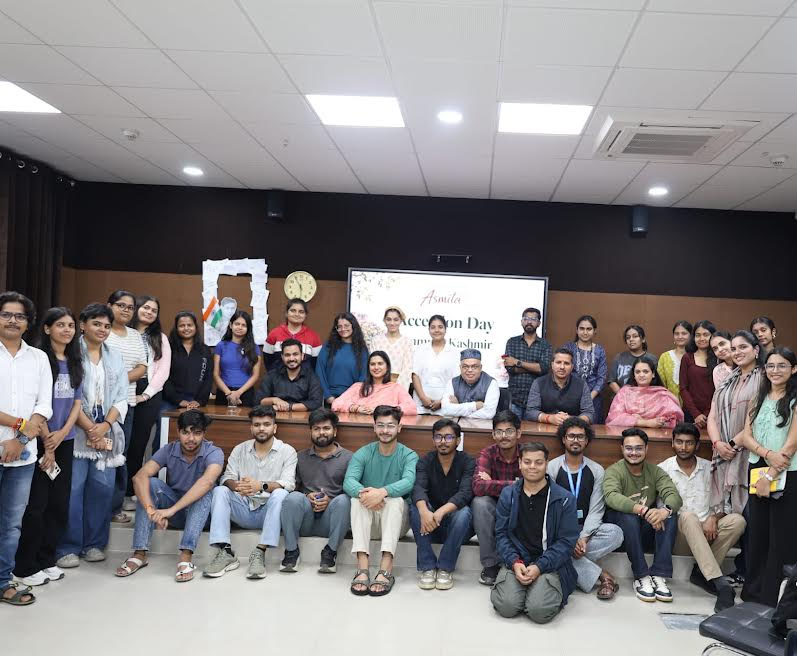
The Indian Institute of Mass Communication (IIMC), Jammu, observed the Accession Day of Jammu and Kashmir with an engaging programme that brought together faculty members and students to reflect on the region’s history, cultural identity, diverse experiences and enduring resilience. The event highlighted the importance of understanding Jammu and Kashmir beyond prevailing perceptions and emphasised the responsibility of media students to tell the region’s stories with sensitivity, accuracy and depth. The programme began with faculty members sharing their perspectives on the day and its relevance to the region’s historical and contemporary identity. Assistant Professor Dr. Vinit Utpal provided a historical overview of Accession Day, highlighting the significant role of Maharaja Hari Singh in the accession of Jammu and Kashmir to India. He also traced the region’s transformation from the period of Partition to the present, offering students an opportunity to reflect on the historical developments that have shaped its contemporary realities. Assitant Professor Ms. Shruti Arora spoke about the perceptions surrounding Jammu and Kashmir and the many untold stories that often remain overshadowed by preconceived notions. Emphasising the responsibility of media students, she encouraged them to look beyond established narratives, understand the region’s ground realities and explore the stories emerging from its distinctive geographical, social and cultural landscape.
Teaching Associate Gulshan Kumar further elaborated on the region’s history, geography and complex identity, highlighting the emotional and human dimensions of Jammu and Kashmir. His address prompted students to reflect on how much the region encompasses beyond what is commonly represented in the media. He also invited students to share their personal experiences of living and studying in Jammu.
The ensuing interaction became a meaningful exchange of experiences, as students from diverse backgrounds spoke about their families’ initial apprehensions regarding their decision to study in Jammu and Kashmir. Many recalled how their families’ perceptions had been shaped by media coverage and prevailing narratives. However, their experiences after arriving in Jammu had significantly altered those views. Students spoke about the warmth and hospitality of the people, their resilience in the face of adversity and the struggles that continue to affect communities across the region.
They also reflected on the historical, geographical and economic challenges faced by its people. Many shared how their perspectives had evolved and how, over time, Jammu and Kashmir had become a second home to them.
The programme then moved to student presentations, which brought personal experiences and human-interest narratives to the forefront.
Ankit Patel, a student of M.A. New Media Communication (NMC), third semester, shared his journey of exploring Jammu and Kashmir beyond the perceptions he initially held. Through his travel experiences, he spoke about visiting both well-known and lesser-explored destinations and discovering the region’s diversity, beauty and welcoming communities. He emphasised that his experiences had challenged his stereotypes and strengthened his belief that exploring the region firsthand was one of the best decisions he had made.
Kalpana, a student of M.A. NMC, first semester, delivered an emotionally resonant presentation on the everyday struggles and indomitable spirit of the people of Jammu and Kashmir.
Through her storytelling, she highlighted the strength and perseverance with which people navigate challenges, encouraging the audience to connect more deeply with their experiences and realities.
Abhinav Mishra, a student of the Postgraduate Diploma in Hindi Journalism, spoke about his initial hesitation before coming to Jammu and how his perceptions had changed after experiencing the region firsthand. Reflecting on his journey at IIMC Jammu, he shared how encounters with local communities and their stories had broadened his understanding and challenged his earlier assumptions.
Adding a critical media perspective to the discussion, Assitant Professor Dr. Ravinder Singh, faculty member at IIMC Jammu, addressed the role of media in shaping public perceptions of Jammu and Kashmir. He discussed the circulation of misleading narratives, the portrayal of the region as a conflict zone and representations surrounding Pakistan-occupied Jammu and Kashmir (PoJK). He stressed the need for responsible, evidence-based journalism that examines complex issues carefully and avoids reducing the region to a single narrative. He urged students to recognise their potential as future media professionals to challenge misinformation, question stereotypes and bring nuanced, ground-level stories to public attention.
The Regional Director of IIMC Jammu Dr. Dilip Kumar in his address, celebrated the achievements of para-archers Sheetal Devi and Rakesh Kumar, whose accomplishments have brought recognition to Jammu and Kashmir. He commended their determination, talent and ability to overcome personal challenges, noting how their journeys exemplify the region’s extraordinary potential and the resilience of its people.
Concluding the programme, the Regional Director reiterated the importance of remembering Accession Day as an occasion to reflect on the region’s history, the consequences of Partition, its transformation over the decades and the challenges that remain. He emphasised the courage, compassion and perseverance of the people of Jammu and Kashmir, underlining the need to understand their experiences with empathy and historical awareness.
The programme was moderated by Ms. Delisha Arora, who opened the session by highlighting the historical significance of Accession Day and the importance of understanding the region’s past and present, particularly for students pursuing their education in Jammu and Kashmir
The programme served as a platform for historical reflection, personal storytelling and critical engagement with media narratives. By bringing together faculty insights and students lived experiences, the observance reinforced the importance of looking beyond stereotypes and recognising the many voices, identities and stories that shape Jammu and Kashmir.
The event concluded with a renewed sense of responsibility among students to approach the region with curiosity, sensitivity and an informed perspective, reaffirming the role of future media professionals in presenting its stories with accuracy, fairness and humanity.

