

























DC flags off rally; Emphasis on Drug-Free, Responsible Youth
DH NEWS SERVICE
Jammu , Apr 10
SS Innovations International, the maker of India’s first and only home-grown surgical robotic system, SSI Mantra, successfully hosted the Third Global SSI Multi-Specialty Robotic Surgery Conference (SMRSC) 2026 at Bharat Mandapam, Pragati Maidan, New Delhi. On the first day, the conference witnessed participation from over 1,500 doctors and 250+ leading experts from across the world, reinforcing it’s position as a premier platform for advancing robotic-assisted surgery and next-generation healthcare technologies.
Building on the momentum of previous editions, SMRSC 2026 brought together global surgeons, healthcare leaders, researchers and innovators to explore the transformative potential of robotic surgery, artificial intelligence, telesurgery and mobile surgical platforms. The conference featured live telesurgeries, scientific sessions, immersive technology showcases and hands-on experiences, offering a comprehensive view of the rapidly evolving surgical landscape. Over the course of the three-day conference, a total of 15 live telesurgeries and 14 live surgeries will be performed using the Mantra-3 and MantrAsana systems, offering attendees a first-hand view of advanced robotic surgical capabilities in action.
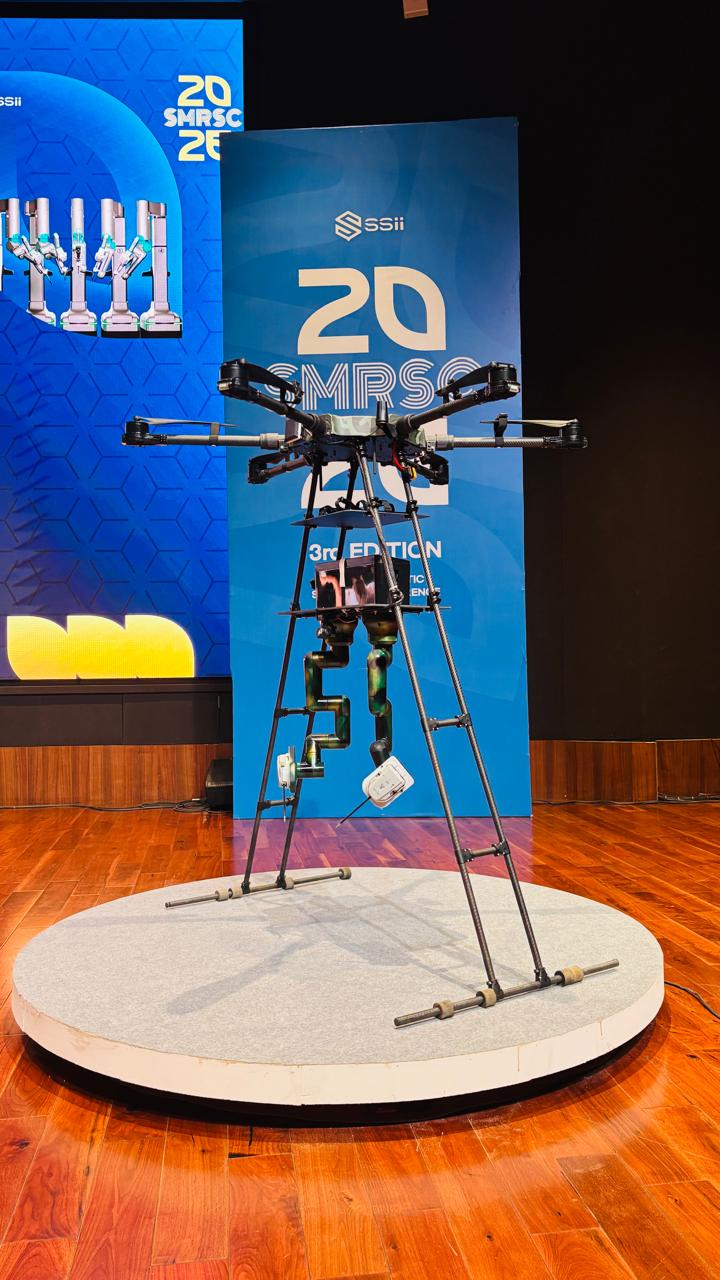
A defining highlight of SMRSC 2026 was the unveiling of two groundbreaking innovations that signal the next frontier in surgical mobility and accessibility. Taking centre stage, Project Vimana emerged as a game-changing advancement in battlefield and emergency medicine. Designed to deliver expert robotic surgical care directly to wounded soldiers in forward combat zones, the system is deployed via a heavy lift autonomous drone and lands near the casualty site. Equipped with dual 7-degree-of-freedom miniature robotic arms and advanced surgical instruments, Project Vimana enables trauma surgeons to perform life-saving procedures remotely through the SSI Mantra Surgeon Command Center. From haemorrhage control and chest decompression to shrapnel removal and wound repair, the system bridges the critical gap between injury and evacuation, bringing surgical precision to environments where immediate medical access is otherwise impossible. This innovation represents a paradigm shift in emergency response, transforming how critical care can be delivered in high-risk, time-sensitive scenarios.
Complementing this vision, Project Operion showcased the future of surgical infrastructure through a fully mobile, platform agnostic operating room ecosystem. Built on a wheeled chassis with Overhead-Integrated Robotics and a Zero-Footprint Architecture, Operion eliminates conventional spatial constraints by suspending all surgical components from an integrated overhead system. This enables 360-degree clinician access, real-time reconfiguration, and seamless deployment across hospitals, remote locations, and disaster zones. With integrated telesurgery capabilities and low-latency connectivity, Operion allows expert surgeons to operate remotely, expanding access to advanced surgical care across geographies.
From defence operations to humanitarian missions and rural healthcare delivery, Operion transforms the operating room into a deployable, mission-ready asset.
Further strengthening the innovation momentum at SMRSC 2026, SS Innovations International unveiled a Single Arm Robotic Endoscopy and Ultrasound Assist Cart, representing a notable advancement in diagnostic and interventional robotics. Designed to provide stable, precise, and repeatable positioning of endoscopic and ultrasound instruments within clinical environments, the SSI Technologies Single Arm system brings robotic consistency to diagnostic workflows. Operating under direct clinician supervision, the robotic arm incorporates controlled speed, force limits, and predictable motion behaviour, ensuring safe interaction with both patients and operators. Its compatibility with standard hospital infrastructure and existing clinical workflows ensures seamless integration into established clinical settings.

