

























new delhi, Mar 2
Crude oil prices spiked dramatically on Tuesday morning, with Brent jumping nearly 13% to over $82 following news of joint U.S.-Israeli strikes on Iran and the reported death of Iran’s Supreme Leader. Throughout the day, the market remained on edge as the Strait of Hormuz saw a near standstill in tanker traffic on March 1, though prices cooled slightly by evening to settle around $78 for Brent and $72 for WTI.
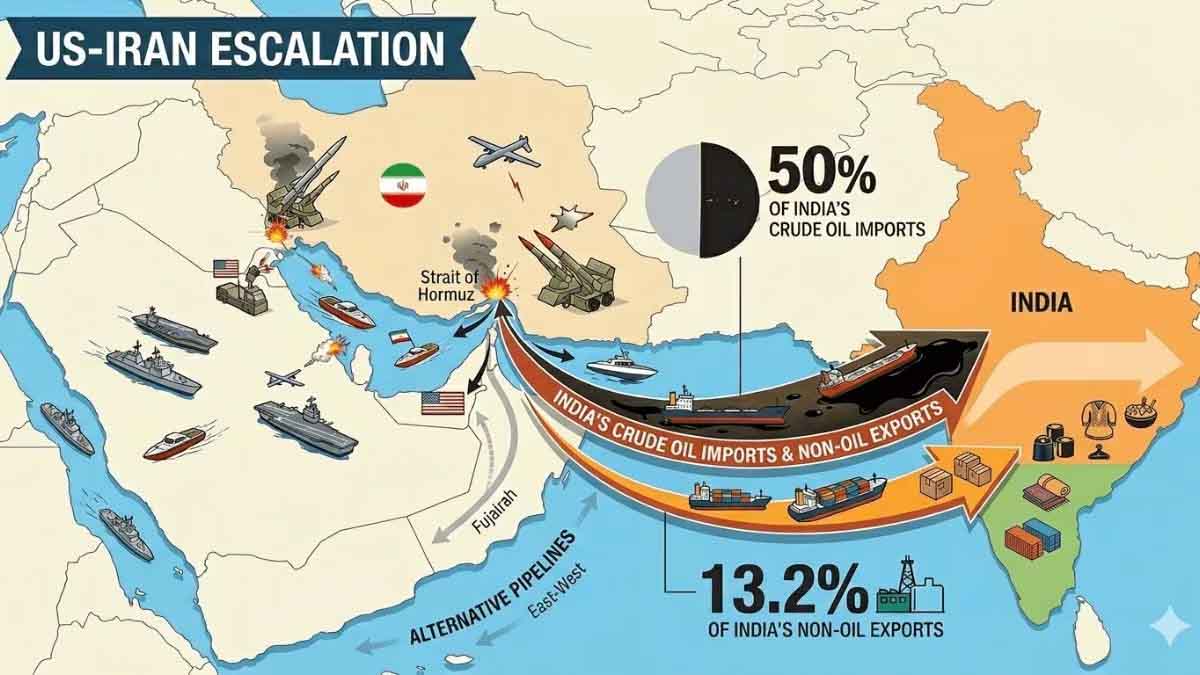
Crude tanker movement through the Strait of Hormuz dropped sharply on March 1, with only one crude vessel transiting the key corridor, potentially raising supply and cost concerns for India, which routes nearly half its crude imports through the waterway.
With Brent trading near $80 per barrel amid rising geopolitical risk premiums, refiners may increasingly recalibrate sourcing beyond West Asia toward the United States, Brazil, Guyana, Nigeria and Angola, alongside existing Russian volumes, a senior official aware of the development said, though longer voyages are likely to raise landed costs. Monday’s spike largely reflected a swift geopolitical risk repricing, with the move broadly within the $5–$10 per barrel range driven by fear premium rather than any immediate physical supply disruption.
What do analysts say?
“Kpler AIS data indicates a sharp fall in crude tanker movements through the Strait of Hormuz on March 1. Crude and condensate volumes passing through the Strait of Hormuz dropped to around 2 million barrels per day on March 1, compared with roughly 17–19 million barrels per day on February 27–28. In vessel terms, only one crude tanker transited the Strait on March 1, versus 11 crude tankers on February 28 and 10 on February 27,” said Nikhil Dubey, Senior Refining Analyst, Kpler.
“Notably, AIS tracking shows that no India-bound crude tanker passed through the Strait on March 1. The scale of the decline highlights the immediate disruption in crude flows through this key global energy corridor,” he added. India’s inventory buffer may provide near-term stability. “India’s crude stocks are around 100 million barrels, including SPR held in strategic reserves at Mangalore, Padur, and Visakhapatnam. With imports via the Strait of Hormuz averaging roughly 2.5 million barrels per day — about 50% of India’s ~5 mb/d total crude imports — these combined reserves could theoretically cover close to 40–45 days of imports in a disruption scenario from a crude perspective. In addition, companies also hold refined product inventories, which would extend effective coverage further,” Dubey said.. Prashant Vasisht, Senior Vice President and Co-Group Head, Corporate Ratings, ICRA Ltd, said strategic and operational storage combined, including ports and refinery tankages, is about 74 days. While this cushion may limit immediate supply disruption, cost escalation remains a key risk.
Analysts on India’s energy diversification stratergy
On diversification, Vasisht said: “Yes India could look at diversifying. Refinery compatibility is not an issue. However freight costs would be higher. Per barrel cost from ME would be 40–70 cents while from Americas it would be $2.5–4.” Transit timelines underscore the cost differential. Yogesh Jambhale, Senior Manager – Research, Rubix Data Sciences, said Middle Eastern barrels from Iraq, Saudi Arabia, UAE and Kuwait reach India in 4–7 days, whereas crude from Brazil or Guyana takes 25–45 days. “The longer Atlantic route raises freight and insurance costs, increases inventory carrying expenses, ties up working capital for longer periods, and reduces refiners’ ability to respond quickly to price swings,” he said.
Diversification is already visible. Indian Oil Corporation recently purchased 2 million barrels of Brazil’s Buzios crude for March loading. Brazil currently accounts for roughly 1% of India’s crude imports, though import value rose to USD 1 billion in April–December FY26 from USD 562 million a year earlier. India also imported around 297,000 bpd of Guyanese crude in January 2026.
Apart from Brazil and Guyana, refiners may evaluate incremental cargoes from the United States and West Africa, particularly Nigeria and Angola, depending on freight economics and availability. Russian supplies also remain part of India’s import basket. While these sources may not fully substitute volumes from Iraq, Saudi Arabia, the United Arab Emirates and Kuwait, they could serve as supplementary hedges to balance transit risk.
Amid the developments, the Ministry of Petroleum & Natural Gas said it is closely monitoring the situation. “In view of ongoing geopolitical developments in the Middle East, the Minister of Petroleum & Natural Gas reviewed the supply situation for crude oil, LPG, and other petroleum products with senior officials from the Ministry and PSUs. We are continuously monitoring the evolving situation, and all necessary steps will be taken in order to ensure availability and affordability of major petroleum products in the country,” the ministry said in a post on X.
The macro impact of higher crude remains significant. Vasisht cautioned: “Import bill would go up by $13–14 billion annually for every $10/barrel rise in average crude cost. OMC margins would be adversely impacted due to lower marketing margins and higher LPG under recoveries at elevated crude prices.”

