
























BY RAJDEEP PATHAK
In an era defined by electoral intensity and unceasing political spectacle, the quiet moral authority of history often fades into the background. As states like West Bengal, Tamil Nadu and others enter fiercely contested elections, as tribal communities in Madhya Pradesh, Odisha, Jharkhand stand resolute to protect their ancestral lands, and as unrest continues to trouble Manipur, a deeper question emerges – will the world still listen to the enduring call for peace, justice, and moral courage that once transformed societies? This crisis is not India’s alone.
It reflects a wider global unease. From the devastation in Gaza to the prolonged war in Ukraine, and from the overlooked conflicts in Sudan to the violence in the Democratic Republic of the Congo, the scale and speed of modern warfare have begun to outpace the world’s commitment to dialogue and diplomacy. Strategic interests increasingly overshadow human values, and the ideals of non-violence and ethical governance are too often dismissed as impractical in a hardened geopolitical climate. At its core, this moment reflects a growing tension between the assertion of power and the suffering of ordinary people. It is a turning point that demands a choice – whether to remain passive observers to deepening divisions, or to rediscover the moral imagination needed to bridge them.
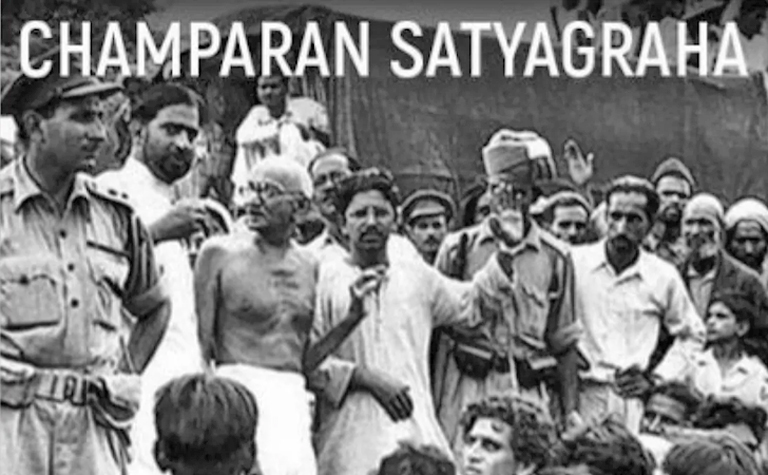
In such a fraught moment, the memory of the Champaran Satyagraha needs to be revisited for it was in April 1917 the first non-violent ‘satyagraha’ by Mahatma Gandhi had begun. It is not merely an episode from the past, but a living reminder that meaningful change can emerge from courage rooted in truth and non-violence. For the world at large, and for the broader aspiration of a just and developed future, the message endures. It reiterates that progress cannot be measured by power alone, but by the depth of compassion and the strength of moral conviction. Also, to move forward without losing its soul, the global community must decide whether it will remain a spectator to its own fragmentation or reclaim the radical empathy required to heal these widening divides.
in 1917 was not a symbolic theatre of politics. It was an agrarian inferno. Under the tinkathia system, indigo farmers were forced to cultivate indigo on a quarter of their land for the benefit of British planters, regardless of soil quality or family need. Synthetic dyes had already made natural indigo redundant in European markets, yet the colonial regime kept the system alive purely to extract rent and profit. Farmers cycled through debt, hunger, and indignity, locked in orally enforced leases that they could neither read nor challenge. When Gandhi arrived in Motihari on 10 April 1917 at the persistent invitation of a farmer Rajkumar Shukla, he chose not to speed launch a movement against the British, but to listen to the woes of the farmers and cultivators. Sitting under village trees, he recorded over 8,000 testimonies, converting muffled voices into a documented moral indictment of the regime. He came with a method, which was ‘Satyagraha’, anchored in truth, non-violence, and the dignity of the oppressed. From this meticulous listening arose both the Champaran Agrarian Act of 1917 and the deeper revolution of consciousness, which was the shift from subjects ruled by fear to citizens empowered by truth. Mohandas Karamchand Gandhi treated education, health, and hygiene as inseparable from politics. His wife and companion in his struggle, Kasturba Gandhi, taught basic health and literacy in villages like Bhitiharwa and Barharwa Lakhansen, while local women wove their own experiences into the collective narrative of resistance. This was not merely a ‘peasants’ revolt’. It was a non-violent reimagining of power, where the poor speak, decide, and redeem themselves without descending into vengeance. In April 2026, Samrat Choudhary, a BJP leader, became the first Chief Minister of Bihar from his party in the state’s 46-year association with the BJP.
After decades of complex coalition politics and the long tenure of Nitish Kumar, this shift marks a new chapter in Bihar’s governance. For a first time BJP CM, the question is not merely about GDP growth figures or slick infrastructure, but whether his government can look back to the Satyagraha of Champaran and remember that Bihar’s deepest political legacy is not in the power corridors outside its state, but in the dusty fields of Motihari, where an imprisoned and throttled peasantry forced a mighty empire to concede.
Gandhi did not enter Champaran to win a popularity contest. He entered because he listened first and then acted with calibrated, non-violent pressure. Beyond Champaran, the same struggle for land and dignity now echoes in the forests of Madhya Pradesh, Jharkhand, Odisha, where the tribals protest to protect their community rights. Further, while Champaran speaks of a non-violent, dialogue-based resistance, a contemporary Manipur reveals how easily the language of peace can be hollowed out. The 2023-2026 conflict in Manipur has left trails of violence, displacement, anger with periodic clashes, internet shutdowns, and a major trust deficit.
In such a climate, the (world’s) talk of peace feels like a distant song, echoing through conference halls, yet far removed from the reality of burned villages and forests and grieving homes.
The question before India is not just legal, but civilizational. Will its sacred forests remain sacred, or will they be chopped down in the middle of the night to make way for concrete structures and carbon heavy projects? Gandhi’s Champaran campaign was rooted in the idea that land is not merely real estate. It is the basis of life, culture, and self respect.
A true Viksit Bharat 2047 – which we all aspire for – would place forest rights, water security, and ecological resilience and sustainability at the heart of its development matrix. For, the official vision of Viksit Bharat 2047 speaks of a self-reliant, prosperous India with strong infrastructure, advanced technology, and higher per capita income.
Economic targets include a GDP in the range of USD 30-40 trillion and per capita income around USD 15,000-18,000 by 2047, with goals of ‘zero poverty’ and universal access to quality education and health.
These are ambitious numbers, but they will remain empty without a moral architecture. The saddening part is that, across the world, the rhetoric of peace often coexists with the reality of conflict. Nations speak of diplomacy while preparing for war. Leaders invoke unity while deepening divisions. This paradox is not new, but it has become more pronounced in an era of instant communication and amplified narratives. The challenge is not the absence of messages of peace, but it is the unwillingness to internalize them.
Peace, per se, cannot be performed. It must be built. It requires trust, dialogue, and a genuine commitment to addressing grievances. The challenge before policymakers, leaders, and citizens alike is also to bridge the gap between rhetoric and reality. Champaran reminds us that peace is not passive. Gandhi’s peace was a form of courage. Champaran’s legacy further suggests that the test of development lies not only in the height of towers, but in the depth of empathy too. Gandhi’s Champaran was not about rejecting progress. It was about redefining it. In the 109th year of the Satyagraha, we must realize that Champaran was not an isolated episode. It was a beginning, marking the emergence of a new political consciousness, one that placed ethics at the centre of action.
In today’s complex and often fragmented world, revisiting that consciousness is not an exercise in nostalgia. It is a necessity. As the dust of elections settles and new governments take charge, as protests rise and subside, and as the machinery of development continues its relentless march, the echo of Champaran remains. It asks uncomfortable questions, demands honest answers, and reminds us that the true measure of progress lies not in what we build, but in what we preserve.
(The writer is Programme Executive, Gandhi Smriti and Darshan Samiti.)