



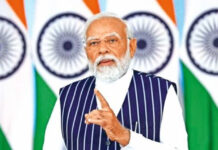















PM Modi invites world to host data in India
DH NEWS SERVICE
New Delhi, feb 15
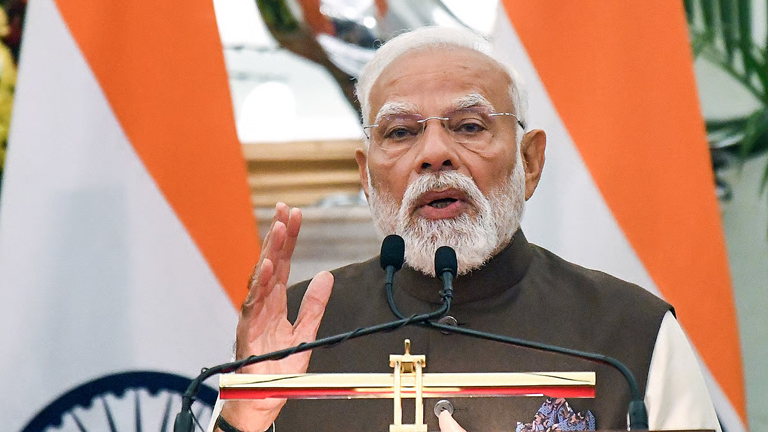
In a sharp take down of trade negotiations during the UPA government, Prime Minister Narendra Modi on Sunday said its “economic mismanagement” left India unable to negotiate from a position of confidence and could never conclude any talks.
In an exclusive interview with PTI, Modi said India’s deals signed with Australia, New Zealand, the UK, the EU, and the US have opened access for MSMEs, particularly in labour-intensive sectors, to export to these regions with near-zero tariffs or tariffs much lower than those of other exporting countries.
“These trade agreements may have happened recently, but they are the outcome of a more competitive domestic industry, a confident approach and an open outlook. These are rare qualities in today’s world. Before we speak of India’s successful trade agreements in recent years, it is important to recall where we stood just over a decade ago,” the prime minister said.
During the years of the UPA government, they tried to secure some trade deals, and yet the journey was marked by “uncertainty and inconsistency”, Modi said.
“Largely because their economic mismanagement left India unable to negotiate from a position of confidence. They did not lay the environment to bring negotiations to a conclusion. Talks would begin and then break down. In the end, despite prolonged negotiations, very little of real substance was achieved,” he said, hitting out at the Manmohan Singh dispensation.
“But once we came in, we led an economic resurgence through our policy-driven governance, strengthened our economic fundamentals and created a rules-based system. When we ensured political stability, policy predictability and a reform-oriented approach, the world wanted to invest in India,” he asserted.
Modi said his government’s reforms helped both India’s manufacturing and service sectors and encouraged productivity and competitiveness among MSMEs.
As a confident, competitive and fast-growing economy, many nations saw the benefits of pursuing trade agreements with India, he said.
“To understand the difference between the earlier approach and ours, consider the EU trade agreement. It was discussed and negotiated even under the previous government. But it was our government which eventually sealed a win-win deal for our economies,” the prime minister said in a written interview.
Over the last few years, he said his government has built a strategic and purposeful network of Free Trade Agreements.
“We now have FTAs with 38 partner nations, an unprecedented milestone in India’s trade history. A remarkable feature of these trade agreements is that they span continents and include countries of varying economic strength. This gives our manufacturers and producers enough diversity and depth to sell our products across many markets,” Modi said.
These FTAs have opened up the markets of major economies to India’s manufactured products, Modi said and cited the example of the India-UK FTA and the India-EU FTA that will eliminate tariffs on 99 per cent of India’s exports to these countries.
He pointed out that merchandise trade with both Australia and the UAE has doubled since the signing of FTAs with these countries.
“Our service sector and its professionals are well known worldwide. They have already made India a hub of Global Capability Centres in different domains. These trade agreements have further boosted their opportunities with greater regulatory certainty, mutually beneficial frameworks and greater mobility across our partner nations,” he said.
The country’s manufacturing sector has been taking “giant strides” in over the past few years and these trade agreements will help integrate India and Indian products more deeply into global supply chains, he asserted.
“They will give better returns to Indian producers and manufacturers and also contribute to increasing prosperity for our people. The trade agreements of the past few years have come at a historic and opportune time for both our manufacturing and service sectors.
“They are creating a huge number of opportunities for our youth. I am confident that they will make an impact on the world with the quality and competitiveness of our goods and services,” he said.
Modi further said that once Indian youth make an impact on the minds of the common people of partner nations, there will be no looking back.
“These trade agreements are significant not merely because of tariff reductions but because of supply-chain integration and market access in advanced economies. They gradually liberalise manufacturing tariffs, deepen services integration and create new avenues for labour-intensive exports such as textiles, footwear, electronics and engineering goods,” he said.
In that sense, they support structural transformation rather than simply boosting headline trade numbers, he added.
“These FTAs also anchor domestic reform to external commitments. They widen export opportunities, reduce tariff disadvantages relative to competitors, and integrate Indian firms more deeply into global value chains. They reinforce India’s transition toward becoming a more open, confident and globally engaged economy, aligned with the long-term vision of Viksit Bharat by 2047,” Modi said.
Asked about MSMEs having featured prominently in the recent trade agreements, Modi said, “We are entering into these historic trade deals from a position of strength. The vision of Made in India has filled our MSMEs with new confidence and vigour.”
With the Budget providing incentives to turbocharge investments in data centres, Prime Minister Narendra Modi on Sunday pitched India as a global hub for digital infrastructure and artificial intelligence, saying the country is ready to host the world’s data and lead the next wave of the technology revolution.
“The tax incentives announced in the Budget are designed to accelerate investment in this space, lower the cost of building advanced facilities and position India as a globally-competitive destination for data infrastructure,” Modi said in an exclusive interview to PTI.
In a strong global-outreach message, the prime minister said, “We invite the whole world’s data to reside in India!”
In the just-unveiled Budget for the financial year starting April, Finance Minister Nirmala Sitharaman has announced that the likes of Amazon, Google and Microsoft could receive a tax holiday until 2047 on global cloud revenues if they route foreign workloads through Indian data centres.
Also, data-centre services are now eligible for a coverage under the Safe Harbour Rules, with a margin of 15 per cent, as the Budget 2026-27 has pushed to attract AI investment, boost infrastructure and jobs, while managing competition, data protection and enforcement risks.
Modi underscored the importance of data centres. “When we think of technology, we often focus on what is visible, such as applications, platforms and devices. But equally important are the foundational layers that make all such things possible. Data centres are one such critical layer,” he said.
Linking this to AI, the prime minister said, “The importance of this becomes even more apparent when we look at the domain of artificial intelligence. AI needs computing power and data-centre infrastructure. By expanding capacity today, we are laying the foundations for a thriving Indian AI ecosystem.”
Recognising this potential, major investments have already been announced in this space by international and Indian companies in the recent past.
“The tax incentives announced in the Budget are designed to accelerate investment in this space, lower the cost of building advanced facilities and position India as a globally-competitive destination for data infrastructure. The result of this, too, will be a massive number of jobs for our youth,” Modi said in the written interview.
In a strong pitch to global investors, the prime minister added: “We invite the whole world’s data to reside in India!”
His pitch came a day before India hosts the global assembly of tech tycoons, AI business leaders, policymakers, investors and innovators. The Global AI Impact Summit, to be held in New Delhi from February 16 to 20, will see a host of heads of state and government, including France’s Emmanuel Macron and Brazil’s Luiz Inácio Lula da Silva, along with the representatives of more than 60 other countries.
Modi said India must move beyond digital adoption to digital leadership, arguing that in a technology- and data-driven world, leadership, and not mere participation, will determine inclusion, competitiveness and growth.
“The world has been undergoing significant shifts in its technological landscape. Now, nations cannot be content with just digital adoption but must also aspire to digital leadership. As we saw in the digital payments space, only with digital leadership will digital inclusion become possible,” he said.
Drawing a historical contrast, the prime minister added: “During the Industrial Revolution, we were left behind due to colonisation. During the earlier manufacturing revolution, we were left behind due to neglect by post-independence governments. But now, in this technological and data-driven revolution, it is important that we take the lead.”
He said India’s scale and diversity give it a unique advantage.
“India, with an aspirational population of 140 crore people, is one of the world’s largest generators and consumers of data. We are one of the most diverse nations in the world and our data also reflects this diversity. Such a massive and diverse data pool has great potential only when it can be leveraged safely and productively. So we are paying attention to every aspect of the data ecosystem, including security, skills, software and infrastructure,” the prime minister said.
On safeguards, he pointed to the Digital Personal Data Protection Act, 2023.
“For security, we brought in the digital personal data protection law to build a safe, secure, privacy-protecting, rights-based framework that empowers citizens,” he said.
Modi said India’s strength in talent and software is already recognised globally.
“As for skills and software, the talent of Indian youth in the data-science space is world-renowned,” he asserted.

