















DH NEWS SERVICE
SRINAGAR, july 23
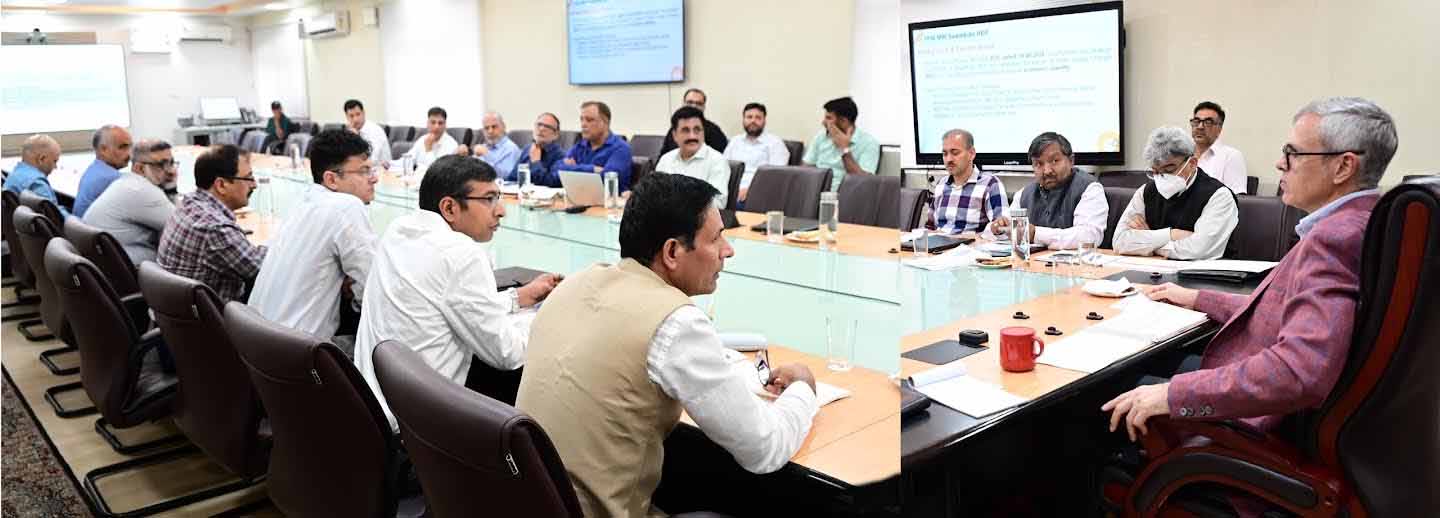
Chief Minister Omar Abdullah on Tuesday chaired a high-level review meeting to assess the progress of key hydro and solar power projects in Jammu and Kashmir, placing strong emphasis on timely execution and removal of project-related bottlenecks. The meeting, held in Srinagar, was attended by top bureaucrats and officials from the state’s power and finance departments, underlining the government’s renewed commitment to strengthening energy infrastructure and embracing renewable energy as a strategic priority. Those present at the meeting included Chief Secretary Atal Dulloo, Additional Chief Secretary to the Chief Minister Dheeraj Gupta, Principal Secretary Finance Santosh D Vaidya, Principal Secretary Power Development Department Rajesh H Prasad, as well as the Managing Directors of the Jammu and Kashmir Power Distribution Corporation Limited (JKPDCL) and other relevant stakeholders. The agenda was clear: to push forward stalled or delayed power projects, identify pain points, and discuss the roadmap for Jammu and Kashmir’s future energy needs.
One of the key items on the Chief Minister’s agenda was the review of major hydroelectric projects, including the 1856 MW Sawalkote Hydro Electric Project, the 93 MW New Ganderbal Hydro Electric Project, and the 48 MW Lower Kalnai Hydro Electric Project. These projects, once operational, are expected to significantly bolster the region’s energy generation capacity and reduce dependence on power imports from the national grid.
While expressing concern over the slow progress of the New Ganderbal and Lower Kalnai hydro projects, the Chief Minister pointed to financial and contractual obstacles as major causes of delay. He directed the concerned departments to actively explore viable alternatives that could accelerate execution, whether through renegotiation of contracts, re-tendering of work, or onboarding new implementation partners. Omar Abdullah stressed the importance of time-bound decision-making, highlighting that further delays could lead to sharp cost escalations and deepen energy deficits, particularly during peak demand months. The discussion also touched upon another crucial area-solar energy. The Chief Minister reviewed the status of the 5 MW Solar Power Project at Pampore, which is being implemented through the Solar Energy Corporation of India (SECI). He called for a comprehensive cost-benefit analysis of the project, especially in the context of current market rates for solar power and evolving technology trends. In addition, he suggested that the idle land in Pampore be put to productive use by either scaling up the solar project or using the space for complementary clean energy ventures. His remarks underscored the administration’s intent to not only diversify the energy mix but also maximize the utility of government land holdings in an environmentally conscious manner.
Another major focus of the meeting was the issue of unpaid electricity dues, particularly from commercial power consumers. The Power Development Department gave a detailed briefing on the arrears accumulated over the past few years and outlined the corrective measures it intends to propose. These include possible incentive-based recovery schemes, installment-based payment mechanisms, and stronger enforcement strategies aimed at improving financial health and revenue collection. The Chief Minister emphasized that while infrastructure development is critical, efficient revenue management is equally important to maintain the sustainability of the power sector.
In a forward-looking move, the meeting also discussed the Draft Hydro Power Policy 2025. The new policy, which aims to replace the decade-old Hydro Power Policy of 2011, is designed to attract both domestic and foreign investments in Jammu and Kashmir’s power sector. The proposed policy focuses on creating a robust and transparent ecosystem for project allotment, ensuring time-bound clearances, offering fiscal incentives, and guaranteeing the purchase of generated power by state utilities. These reforms are intended to enhance investor confidence and increase the participation of Independent Power Producers (IPPs) and Public-Private Partnerships (PPPs) in the region’s energy sector.
Chief Minister Omar Abdullah expressed his full support for the revised policy framework and reiterated his government’s commitment to clean energy, sustainable growth, and equitable development. He noted that the new policy aligns with broader national goals of achieving renewable energy targets and ensuring energy security. He said that Jammu and Kashmir, with its abundant natural resources and growing infrastructure, is uniquely positioned to emerge as a leader in hydroelectric and solar energy production in the country.
In closing remarks, the Chief Minister stated that the government’s energy strategy must be multi-dimensional-focusing equally on project execution, financial efficiency, sustainability, and private sector participation. He instructed all departments to work in close coordination, resolve outstanding issues promptly, and ensure that power sector development becomes a catalyst for the region’s economic revival and environmental stewardship.

